


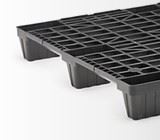


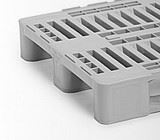




In this post, we examine the fundamental differences between European and American pallets, focusing on their standard sizes. Covering everything from design to functionality, we break down how these differences affect logistics and storage in different regions. Understanding these variations is crucial for companies operating in international markets and looking to optimise their supply chain and transport.
Knowing pallet sizes is essential before sizing a racking system, arranging transport or choosing secondary packaging. A millimetre error can mean pallets that do not fit in the rack, loads that overhang the lorry or poorly used warehouse space.
In this guide you will find the exact measurements of all the pallet types most used in European and international logistics: the Euro pallet, the American or industrial pallet and other variants such as the half pallet or quarter pallet. We also explain how to choose the right format for your operation.
Euro pallet measurements
The Euro pallet or europallet is the standard format in Europe and the most widely used in intra-EU trade. Its 1,200×800 mm dimensions are standardised by the EPAL (European Pallet Association) and also respected by ISPM-15 for international exports.
| Dimension | Measurement |
|---|---|
| Length | 1,200 mm |
| Width | 800 mm |
| Height (empty) | 144 mm |
| Weight | 5-21 kg |
| Static load capacity | up to 7,500 kg |
| Dynamic load capacity | up to 1,750 kg |
| Racking load capacity | up to 1,200 kg |
The europallet fits perfectly in standard European semi-trailers (2,400 mm internal width), allowing two parallel columns of pallets with no wasted space. It is the reference format for pallet racking, road transport and automated warehouses in Europe.
Plastic pallets in Euro format maintain exactly the same external dimensions (1,200×800 mm) but with variations in height and weight depending on the design.
American or industrial pallet measurements
The American pallet, also known as industrial or universal, is the dominant format in the United States and Japan.
In reality, the pallet used in America measures 48" x 40" (1,219.2 x 1,016 mm), which differs slightly from the dimensions of what is called the 'American pallet' in Europe. This difference, although small, is crucial and exceeds the permitted tolerances for interchangeability.
In addition, its dimensions differ from the europallet, generating incompatibilities in mixed logistics chains.
| Dimension | Measurement (mm) | Measurement (inches) |
|---|---|---|
| Length | 1,200 mm | 47.20" |
| Width | 1,000 mm | 39.40" |
| Height (empty) | ~40–162 mm | ~1.57–6.40" |
| Weight | ~6.15-22.8 kg | – |
| Static capacity | up to 8,000 kg | – |
The key difference from the Euro pallet is the width: 1,000 mm vs 800 mm. An American pallet cannot fit in two parallel columns inside a standard European semi-trailer, so they are usually loaded in a single column.
Even so, it remains the second most widely used format in Europe, especially in sectors with heavy or irregular loads: chemicals, pharmaceuticals, automotive and machinery.
Comparative table: measurements of all pallet types
This table summarises the most widely used standard formats in international logistics:
| Pallet type | Length (mm) | Width (mm) | Empty height (mm) | Main use |
|---|---|---|---|---|
| Quarter pallet | 600 | 400 | 35 | Retail, POS, displays, pharmaceuticals |
| Half pallet | 800 | 600 | 35 | Retail, POS, display |
| Euro pallet or europallet | 1,200 | 800 | 40-160 | Europe (road transport, retail, agri-food) |
| American or industrial pallet | 1,200 | 1,000 | 40-162 | Europe (chemicals, pharmaceuticals, machinery) |
| Square pallet | 1,140 | 1,140 | 47 | ISO-type containers, ISPM-15 export |
| Special pallet | 1,300 | 1,100 | 160 | Reuse and stacking storage applications. |
Plastic pallet measurements vs wooden pallets
Plastic pallets replicate standard formats (EUR1, EUR2, GMA) but have dimensional advantages over wooden ones:
| Characteristic | Wooden pallet | Plastic pallet |
|---|---|---|
| Dimensional variation | ±3–5 mm (swelling, deformation) | Constant mould (do not swell or deform) |
| Net height | May vary between units of the same batch | Constant per model |
| Weight | 20–30 kg (depending on species) | 5–22.8 kg (depending on design) |
| Moisture resistance | Low (deforms, rots) | High (inert to water) |
| Rack compatibility | Medium (splinters, loose nails) | High (uniform surface) |
| AS/RS compatibility | Low (variable tolerances) | Very high (mould tolerances) |
| Useful life | 5–10 cycles | Multiple cycles depending on model |
For operations with automated storage, food or pharmaceutical sectors (where hygiene and traceability are critical), European or American plastic pallets are the most common solution.
How to choose the right pallet format
The choice does not depend only on the measurements, but on three factors that must be aligned:
- Racking or storage area format: the installed racking usually determines the format. If you have racking designed for europallets 1,200×800, switching to industrial 1,200×1,000 requires adjusting the beams.
- Type of transport: for road distribution in Europe, the Euro pallet is always more efficient. For export to the US or internal distribution in large warehouses, the American or industrial pallet may be a better option.
- Sector and regulations: food, pharmaceutical and chemical sectors have specific hygiene, material and traceability requirements that normally rule out wooden pallets and point to plastic pallets.
Frequently asked questions about pallet sizes
The standard europallet (EUR.1 / EPAL) measures 1,200 mm long × 800 mm wide. It is the format standardised by the European Pallet Association and the most widely used in European road transport. In reality, the American pallet (GMA) used in America measures 1,219 mm long × 1,016 mm wide (48×40 inches). However, in Europe we call the 1,200 × 1,000 mm pallet the American or industrial pallet. It is wider than the europallet, making it incompatible with distribution in two columns in a European semi-trailer. The main difference is the width: the europallet measures 800 mm and the American pallet 1,000 mm. That difference in width makes the American pallet incompatible with standard European semi-trailers (internal width 2,400 mm). There is no universal maximum height for the load: it depends on the warehouse, the racking and the transport. A standard wooden europallet weighs between 20 and 25 kg, depending on the species of wood and the moisture level. Plastic pallets in Euro format can weigh from 5 kg to 23 kg depending on the design. Yes, plastic pallets are manufactured in the same standard formats as wooden ones (europallet 1,200×800, American or industrial 1,200×1,000, etc.) to ensure compatibility with existing racking, forklifts and semi-trailers. The advantage is that the dimensional tolerance of plastic pallets is lower, making them more suitable for automated warehouses. A 13.6 m long semi-trailer with 2.4 m internal width can accommodate 33 towers of Euro pallets (1,200×800 mm). Depending on the type of pallet and the height, the towers may carry more or fewer pallets. With industrial pallets 1,200×1,000 mm, 26 towers fit.How big is a standard Euro pallet?
What are the measurements of an American pallet?
What is the difference between the European and American pallet?
What is the maximum height of a loaded Euro pallet?
How much does a Euro pallet weigh?
Do all plastic pallets have the same dimensions as wooden ones?
How many pallets fit in a 13.6-metre lorry?


