






If you export goods on wooden pallets, you know ISPM-15 well: phytosanitary treatment, stamped IPPC mark, documentation, and the constant risk that a customs authority holds your shipment if something is not in order. If you export on plastic pallets, ISPM-15 does not apply. No treatment, no mark, no additional paperwork for the pallet.
This exemption is not a legal loophole or a one-off exception: it is the direct consequence of what the standard regulates and what plastic is made of. This guide explains why, which markets it affects, what it means for day-to-day operations, and what concrete advantages exporting companies gain by working with plastic pallets.
What is ISPM-15 (NIMF-15)
ISPM-15 is the International Standard for Phytosanitary Measures No. 15. It is established by the FAO under the International Plant Protection Convention (IPPC) and regulates wood packaging used in international trade.
Its objective is to prevent insects, larvae, fungi and other harmful organisms from travelling inside wood from one continent to another and becoming invasive species. It does not regulate the cargo itself, but the wooden support that carries it: pallets, crates, dunnage and solid wood separators.
What treatments does the standard require for wood
For a wooden pallet to be used in exports to countries that apply ISPM-15, it must have undergone one of these approved treatments:
| Treatment | IPPC code | Description |
|---|---|---|
| Heat treatment | HT | Wood is heated in a kiln until the core reaches 56°C for at least 30 minutes. The most common method in Europe. |
| Dielectric heating | DH | Electromagnetic waves (microwave or radio frequency) are used to heat the wood from the inside. |
| Methyl bromide fumigation | MB | Exposure to fumigant gas for a minimum of 16 hours. Restricted within the European Union; mainly used outside the EU. |
| Sulfuryl fluoride | SF | An alternative fumigant to methyl bromide, with less widespread use and specific regulation depending on the destination country. |
Once treated, the pallet must carry the IPPC mark stamped on at least two opposite faces. This mark includes the IPPC symbol, the country code, the producer or approved treatment provider code and the treatment code applied. If the mark is not visible or has deteriorated, customs may reject the shipment even if the wood was correctly treated.
Why plastic is exempt
ISPM-15 specifically regulates solid wood, because it is the material that can harbour the organisms the standard aims to control. Plastic is not an organic material, has no fibre or internal moisture, and cannot act as a refuge or transmission vehicle for the regulated phytosanitary organisms.
This is why all plastic pallets fall outside the scope of the standard, without exception. It does not matter what the destination country is, the volume of the shipment or the type of goods being transported. No plastic pallet requires phytosanitary treatment or an IPPC mark to cross any customs in the world under ISPM-15.
The plastic exemption from ISPM-15 is not an exception: it is the rule. Plastic pallets have never been included within the scope of this standard.
Wood vs plastic in international export: a comparison
| Criterion | Wooden pallet | Plastic pallet |
|---|---|---|
| ISPM-15 / NIMF-15 | Mandatory (treatment + IPPC mark) | Does not apply |
| Mandatory mark on the pallet | Yes, stamped IPPC mark | No |
| Risk of customs hold due to the pallet | Yes (illegible mark, unrecognised treatment) | No |
| Treatment cost | Yes (authorised treatment provider + certification) | None |
| Additional document management for the packaging | Yes (treatment records, mark traceability) | No |
| Risk of rejection or destruction at destination | Yes, if the pallet fails inspection | No (for phytosanitary reasons) |
Which markets are most affected
ISPM-15 applies to international trade between countries that have adopted it. Within the European Union, shipments between member states are not subject to the standard. Once the destination is outside the EU, the standard applies in full.
The main export markets where ISPM-15 is mandatory include:
- United States: required by USDA-APHIS. One of the strictest controls: shipments with non-compliant wooden pallets can be detained, treated at the exporter's expense or returned to origin.
- China: applies the standard with inspections at entry ports and has intensified controls in recent years.
- Australia and New Zealand: particularly strict phytosanitary policy. Their agricultural authorities are among the most rigorous in the world when inspecting packaging.
- Brazil, Mexico and Argentina: active enforcement at ports and land border crossings.
- Japan and South Korea: require certified treatment for all wood packaging.
- United Kingdom: since Brexit, applies the standard independently from the EU.
- Turkey, Switzerland and Norway: although not EU members, apply the standard at their borders.
Exporting with plastic pallets eliminates any phytosanitary issue at all these destinations, with no additional management required.
What it means in practice for exporting companies
The plastic exemption is not just one fewer form to fill out. It has direct consequences for logistics operations:
No treatment cost. Every batch of wooden pallets destined for export must have been treated by an authorised operator. This cost is passed on to the price of the pallet or managed separately. Plastic pallets carry no such surcharge on any shipment.
No risk of rejection because of the pallet. The IPPC mark can deteriorate, become illegible, or fail to meet the format required by the destination customs. A phytosanitary hold can delay a shipment by several days and generate storage and handling costs borne by the exporter. With plastic, that risk does not exist.
No document complexity for the packaging. With wood, every pallet must carry the correct mark, the treatment provider must be recognised by the destination country, and treatment records must be traceable. With plastic, the pallet generates no additional documentation requirements for phytosanitary reasons.
Simpler closed-loop operations. For companies that recover their pallets after delivery, plastic simplifies management: there is no need to verify whether returned pallets are still certified or to worry about treatment expiry between export runs.
Does the plastic pallet need any other certification?
Exemption from ISPM-15 does not mean a plastic pallet is a product with no requirements at all. What it does not have is phytosanitary requirements. Depending on the sector and destination, the goods or the buyer may impose their own requirements:
- Food sector: some buyers or markets require pallets with food-contact certification (compliance with FDA, EFSA or equivalent regulations). This requirement comes from the goods, not from ISPM-15.
- Pharmaceutical sector: pallets may need to meet traceability or hygiene requirements under the GMP or GDP of the destination country. This is also unrelated to ISPM-15.
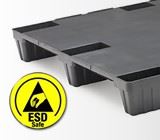
- Electronics sector: if the goods are sensitive to static electricity, pallets with ESD properties may be required, regardless of phytosanitary regulations.
In all these cases, ISPM-15 is not the standard regulating the plastic pallet. Each sector has its own requirements, and plastic pallets can meet them without phytosanitary compliance being one of them.
Naeco models for export
For international export, the most common formats are the Euro pallet (1,200 × 800 mm) and the industrial or American pallet (1,200 × 1,000 mm). Naeco offers models in both formats, all exempt from ISPM-15:
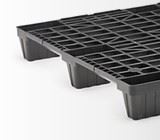
- BASIC 1208-O9 (1,200 × 800 mm, 5 kg): lightweight nestable Euro pallet. Suitable for export in high-turnover circuits where the weight of the empty pallet is a relevant factor.
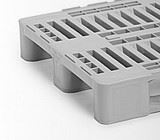
- LOGIC 1208-G3 (1,200 × 800 mm, 12.2 kg): mid-range solid-deck Euro pallet. Greater structural rigidity for loads requiring more resistance in transit.
- EXPERT 1210-O3 (1,200 × 1,000 mm, 21 kg): heavy-duty industrial pallet with a static load capacity of up to 7,000 kg. For export of heavy goods or demanding industrial sectors.
Frequently asked questions
No. The IPPC mark is exclusive to wooden packaging treated in accordance with ISPM-15. Plastic pallets are not within the scope of the standard and do not need that mark. Yes. ISPM-15 exclusively regulates solid wood packaging. The plastic exemption does not depend on the destination country: no country that applies ISPM-15 requires phytosanitary treatment for plastic pallets, because plastic falls outside the scope of the standard by definition. They are the same standard under different names depending on the language. ISPM-15 stands for International Standards for Phytosanitary Measures No. 15, while NIMF-15 uses the Spanish acronym (Norma Internacional de Medidas Fitosanitarias n.º 15). ISPM-15 is the term most widely used in international and trade contexts. Yes. The exemption depends on the material, not the condition of the pallet. A used, repaired or recycled plastic pallet remains exempt from ISPM-15 in exactly the same way as a new one. No. ISPM-15 governs wood packaging in international trade between countries. Shipments between EU member states are not subject to the standard. Once the destination is a third country outside the EU, including the United Kingdom since Brexit, the standard does apply to wooden pallets. The consequences depend on the destination country and the inspector's judgement, but the most common outcomes are: detention of the shipment and a requirement to treat on-site at the exporter's expense, return to origin, destruction of the packaging, or in serious cases, inclusion of the operator on monitoring lists. Any of these situations generates delays, additional costs and problems in the commercial relationship with the buyer. Plywood may be exempt from ISPM-15 under certain manufacturing conditions, but there are nuances and variations by destination country that should be verified with the customs broker in each case. Plastic pallets have none of those nuances: the exemption is total, with no conditions or market exceptions.Does a plastic pallet need to carry the IPPC mark?
Does the plastic exemption apply to every country in the world?
What is the difference between ISPM-15 and NIMF-15?
Are second-hand plastic pallets also exempt?
Does ISPM-15 apply to shipments within the European Union?
What happens if a wooden pallet without ISPM-15 compliance is detected at customs?
Is plywood also exempt like plastic?
If you export and want to remove ISPM-15 from your logistics operations, plastic pallets are the most direct solution. Browse our range of plastic pallets.


