





Knowing how many empty pallets fit in a truck is one of the most common questions in logistics and transport, especially for companies that reposition pallets after delivery, manage a circuit of reusable pallets, or simply need to plan the shipment of empty handling equipment. Knowing this figure accurately allows better load planning, fewer trips and lower cost per unit.
This guide explains the calculations for the most common vehicles in road transport of palletised goods in Spain and Europe.
But before starting, it is important to distinguish between two scenarios:
- Capacity for empty pallets: almost always determined by space (floor area and interior height of the cargo box), because an empty pallet weighs between 1.2 and 25 kg depending on the model.
- Capacity for loaded pallets: determined by space, but also, and often first, by the weight of the goods. A loaded pallet can weigh several hundred or even several thousand kilograms, so the vehicle's weight limit may be reached before the floor is full.
Confusing the two scenarios leads to planning errors: applying a loaded-pallet figure when shipping empty pallets, or using a heavy-goods weight limit for a consignment of empty units. This guide focuses exclusively on the first case: how many empty pallets fit, by size and by their own weight.
Standard dimensions of transport vehicles
Before calculating how many pallets fit, the interior dimensions of the cargo box must be known. These vary by vehicle type:
| Vehicle type | Interior length (approx.) | Interior width (approx.) | Interior height (approx.) |
|---|---|---|---|
| Curtainsider / Tarpaulin trailer | 13.6 m | 2.4 m | approx. 2.6 m |
| Mega trailer | 13.6 m | 2.4 m | approx. 2.9 m |
| Jumbo trailer | approx. 16 m | 2.4 m | approx. 3 m |
| Rigid truck | 7 - 9 m | 2.4 m | approx. 2.5 m |
| Rigid truck + trailer | 12 - 15 m | 2.4 m | approx. 2.5 m |
These are approximate figures. Each manufacturer and model has its own dimensions, so it is always worth checking the vehicle's technical specification before planning a tight load.
How many empty euro pallets fit by vehicle type
The euro pallet measures 1,200 x 800 mm. Using those dimensions and the interior measurements of each vehicle, the floor capacity is as follows:
| Vehicle type | Euro pallet positions on floor | Max. payload (approx.) |
|---|---|---|
| Curtainsider / Tarpaulin trailer | 33 euro pallet positions | Up to 24,000 kg |
| Mega trailer | 33 euro pallet positions | Up to 24,000 kg |
| Jumbo trailer | 38 euro pallet positions | Up to 25,000 kg |
| Rigid truck | 15-18 euro pallet positions | 8,000 - 15,000 kg |
| Rigid truck + trailer | 30-38 euro pallet positions | Up to 24,000 kg |
The most common vehicle for long-distance transport is the standard 13.6-metre trailer, which holds 33 euro pallet positions on the floor. This figure is obtained by placing pallets in 11 rows of 3 units: 11 × 1,200 mm = 13,200 mm in length and 3 × 800 mm = 2,400 mm in width.
What if you use half pallets or other formats?
Capacity varies depending on the pallet format used. Using the standard curtainsider as the example, the capacity would be:
| Pallet format | Dimensions | Positions in standard curtainsider |
|---|---|---|
| Euro pallet | 1,200 × 800 mm | 33 |
| Half pallet | 800 × 600 mm | 66 |
| American / industrial pallet | 1,200 × 1,000 mm | 26 |
How to calculate: the basic formula
The floor capacity calculation is straightforward:
No. of pallets = (interior length / pallet length) × (interior width / pallet width)
Example for a curtainsider with euro pallets:
(13,600 mm / 1,200 mm) × (2,400 mm / 800 mm) = 11.3 × 3 = 33 pallets
The result is always rounded down, as fractions of a pallet cannot be loaded. In practice, a small margin must also be deducted for load tolerances and lateral securing guides.
The weight limit: just as important as space
Volumetric capacity is not the only factor limiting how many pallets fit in a truck. When pallets are loaded with goods, the vehicle's maximum authorised weight may be reached before the space runs out, especially with heavy cargo.
An articulated trailer has a maximum authorised mass of 40 tonnes in Spain and most European countries. After deducting the vehicle's tare weight, the available payload is approximately 24,000 kg.
This means that even if the trailer has room for 33 pallets, if each loaded pallet weighs more than 900 kg the weight limit will be reached before the load is complete. In that case, the actual number of pallets that can be transported is lower than the theoretical figure.
With empty pallets, weight is almost never the limiting factor
Unlike a shipment of goods on pallets, where the weight of the product often exhausts the vehicle's payload before the floor is full, an empty pallet weighs between 1 and 25 kg. This means that in the vast majority of cases, what limits how many empty pallets fit is the available space, not the maximum authorised weight.
The following exercise uses four real Naeco models to calculate how many empty units fit in a standard curtainsider (13.6 x 2.4 x 2.6 m, payload approximately 24,000 kg) and how much that full load of empty pallets would weigh:
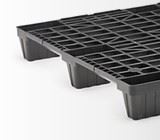
1. Lightweight nestable euro pallet BASIC 1208-O9 (1,200 x 800 mm)
33 positions on the floor, stacked in towers of 62 units, giving a total of 2,046 pallets in one curtainsider. Being nestable, this model is designed precisely to reduce the volume occupied by empty units by nesting them inside one another. The total weight would be 10,230 kg, well within the 24,000 kg capacity.
2. Display half pallet BASIC 0806-O6 (800 x 600 mm)
Half-pallet space: (13,600/600) × (2,400/800) = 22 × 3 = 66 floor positions, or placed on top of a euro pallet in two towers of 71 units each, giving a total of 4,686 pallets. This is also a nestable model designed to minimise empty volume. The total weight would be 13,589.4 kg, also within the 24,000 kg capacity.
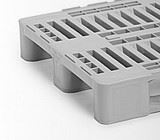
3. Euro pallet LOGIC 1208-G3 (1,200 x 800 mm)
Same floor area as the lightweight euro pallet: 33 floor positions, but as this is a solid-deck, taller, non-nestable model, it can only be stacked in towers of 17 units, giving a total of 561 pallets. This pallet is somewhat heavier (12.2 kg), but because fewer pallets fit in the truck, the total weight is 6,844.2 kg, well below the vehicle's capacity.
4. Industrial pallet EXPERT 1210-O3 (1,200 x 1,000 mm)
Placing the 1,000 mm side along the length of the trailer: (13,600/1,000) × (2,400/1,200) = 13 × 2 = 26 floor positions, in towers of 16 pallets, giving a total of 416 pallets in one curtainsider. This is the heaviest model of the four (21 kg), but because fewer pallets are carried per truck, the load still comes in well below the 24,000 kg capacity.
Conclusion: The heaviest model of the four (the EXPERT) would total 8,736 kg, using only 36.4% of the trailer's payload. In all four cases, the real limit is the available floor space and height, not the vehicle's maximum authorised weight. This is the opposite of what happens when transporting those same pallets loaded with goods, where the weight of the product can exhaust the payload long before the floor is full.
How to optimise loading to make the most of the space
Knowing the theoretical capacity is the first step, but in practice there is room to improve the real utilisation of the vehicle:
Pallet orientation. The euro pallet can be placed in two ways in the cargo box. The standard orientation (800 mm side towards the cab) gives 33 positions in a 13.6-metre trailer. Depending on the exact dimensions of the vehicle, rotating the pallets may allow one or more extra units to fit in the residual spaces.
Route planning with multiple stops. When the truck makes several deliveries, the pallets for the last drop should go to the back of the box and those for the first drop should be closest to the doors. A poorly planned load means moving pallets at every stop, with the resulting time cost and risk of damage.
Uniform pallet height. If all pallets are the same height, it is easier to stack them or use the vertical space with a double-deck system. Irregular heights make stacking more difficult and reduce effective capacity.
Full load vs part load: FTL and LTL
There are two main contracting models in palletised road transport:
FTL (Full Truck Load). The company hires the entire trailer regardless of whether it fills it. This is the most efficient option when there are enough pallets to justify the cost of the full vehicle. The price is negotiated per trip.
LTL (Less Than Truck Load). Also known as groupage, this involves sharing the vehicle's space with other clients' cargo. The carrier groups several part-loads in the same truck and each company pays only for the space it uses. The price is negotiated per pallet or per linear metre of cargo box.
The choice between FTL and LTL depends mainly on volume. As a rough guide, from around 15-18 positions in a trailer upwards, the cost of a full load starts to compete with groupage rates. Below that threshold, groupage is usually cheaper. However, FTL also has advantages beyond price: faster delivery, lower risk of damage and more control over the transit of the goods.
To calculate the cost per pallet under each model, simply divide the total transport cost by the number of pallets sent. Comparing that figure between FTL and LTL across different volume scenarios allows the most cost-effective decision to be made for each shipment.
Frequently asked questions
In a standard 13.6-metre trailer with 2.4 metres of interior width, 33 euro pallets fit on a single layer. The most common arrangement is 11 rows of 3 pallets each. It depends on the goods. The typical maximum load per pallet in general distribution is 1,000 to 1,500 kg, although some pallets are designed for static loads of up to 8,000 kg. For transport planning purposes, 700-800 kg per pallet is a common reference figure for conventional goods. Yes. Refrigerated vehicles have interior insulation that reduces the usable dimensions of the cargo box. The interior length is usually somewhat shorter than in a standard trailer, so capacity may drop to 30-32 euro pallet positions depending on the model, or 33 by reducing the height of some stacks. The pallet format directly determines how many fit in the vehicle. A wider or longer pallet takes up more floor area and reduces the total count. Half pallets allow twice as many units as a euro pallet, which can be useful when distributing to multiple points with smaller orders. Yes, if they have the same external dimensions. A plastic pallet in euro format (1,200 × 800 mm) takes up exactly the same space in a truck as a wooden pallet of the same size. The differences lie in the pallet's own weight (plastic pallets are usually lighter, which frees up some payload capacity) and height (which can vary between models). In a standard 20-foot container (interior length approx. 5.9 m × width 2.35 m), approximately 11 euro pallet positions fit on the floor. In a 40-foot container (interior length approx. 12 m), around 25 euro pallet positions fit. High Cube 40-foot containers have a greater interior height (2.7 m vs 2.4 m in the standard version), allowing better use of stacking space. The most common methods are ratchet straps, anti-tipping bars between the lateral walls of the cargo box, corner protectors for the edges, and anti-slip sheets between levels when stacking. Regulations require the load to be properly secured to prevent movement during transport.How many euro pallets fit in a 13.6-metre trailer?
How much does a euro pallet weigh when loaded with goods?
Does the number of pallets change if the truck is refrigerated?
How does the pallet type affect the number of units transported?
Do plastic pallets take up the same space as wooden ones?
How many pallets fit in a shipping container?
How are pallets secured inside the truck?
Optimising the number of pallets per truck starts with choosing the right format. If you want to know which pallet best fits your logistics operation, Naeco can help. Explore our plastic pallet range.


