


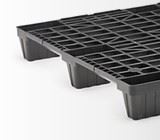


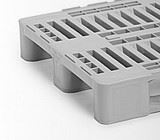
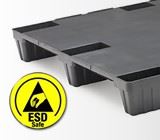
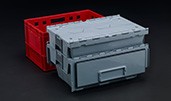

When you look for plastic pallets for your company, you quickly discover that not all of them are the same. There are nestable pallets, four-way entry pallets, lightweight export pallets, display pallets... and each one exists for a reason.
In this guide we explain what sets each type apart, what it is designed for, and which is the most suitable depending on the sector you work in. If you still have questions after reading, at the bottom of the article we explain how to request advice with no commitment.
1. Why there are so many types of plastic pallet
Wood allows few constructive variations. Plastic, on the other hand, can be moulded into geometries impossible for wood. It is injection-moulded to create hollow structures that weigh half as much, fully closed surfaces for maximum hygiene, hollow legs that nest without taking up space, and channels in the deck to fix a display to the pallet.
That design flexibility is precisely why the plastic pallet has become the standard in regulated or more demanding sectors such as food, pharmaceutical, and chemical, and why it continues to gain ground in general logistics.
Most of the plastic pallet types manufactured by Naeco are produced in polypropylene (PP) or high-density polyethylene (HDPE), with certified recycled content.
2. The most common types of plastic pallet
Nestable pallet
The nestable pallet is designed so that, when empty, it fits inside the next one to form a compact stack. It is the preferred choice in distribution logistics and last-mile delivery because it allows ten empty pallets to be returned in the space of two or three.
- Weight: generally between 5 and 9 kg.
- Typical use: distribution, retail, e-commerce, catering.
- Key advantage: dramatic space saving on return transport and in warehouses.
- Limitation: lower load resistance than a solid pallet (not suitable for very heavy loads at height).
4-way entry pallet
Allows a forklift truck to enter from any of the four sides. It is the most universal warehouse format and the one that integrates best with stacker cranes and automated storage systems.
- Weight: between 8 and 25 kg.
- Typical use: high-turnover warehouses, industrial logistics, automotive, etc.
- Key advantage: maximum operational versatility and compatibility with most handling and storage systems.
- Limitation: bulkier design when empty than the nestable pallet.
Closed-deck pallet (solid surface)
The surface is completely closed with no gaps. It prevents any particle, liquid, or contaminant from falling to the level below. It is the most in-demand pallet in hygiene-sensitive areas of the food and pharmaceutical sectors.
- Weight: between 15 and 20 kg.
- Typical use: food, pharmaceutical, cosmetics, and clean rooms.
- Key advantage: the most hygienic surface available (meets the strictest IFS and BRC audit requirements).
- Limitation: heavier weight (not suitable for loads requiring ventilation from below).
Half pallet and quarter pallet
The half pallet (600 x 800 mm) and the quarter pallet (600 x 400 mm) are fractions of the standard euro pallet. They are used in retail to present products directly at the point of sale, for picking of small orders, and in distribution of high-value products.
- Weight: between 1.5 and 5 kg.
- Typical use: retail, supermarkets, fast-moving consumer goods, OTC pharmacy.
- Key advantage: they fit perfectly on shelves and gondolas and are easy to move without a pallet truck.
- Limitation: not suitable for heavy loads; designed for high-turnover products.
Lightweight export pallet
Designed to minimise its own weight, some models do not exceed 6 kg, while maintaining sufficient resistance for loads of between 1,000 and 2,000 kg. They comply with phytosanitary standard ISPM-15, making them ideal for worldwide export without the need for treatment certification.
- Weight: between 3.5 and 7 kg.
- Typical use: intercontinental export, one-way pallet use.
- Key advantage: ISPM-15 compliant, lower shipping cost due to reduced total weight.
- Limitation: shorter useful life and lower resistance than a full industrial pallet.
Display pallet
The display pallet combines transport function with in-store presentation. It usually incorporates areas designed to fix the display to the pallet. Naeco can manufacture them with a custom design.
- Weight: between 1.5 and 5 kg.
- Typical use: product launches, promotions in large retail stores, trade fairs and events.
- Key advantage: saves the time of assembling a separate display; the pallet arrives already set up as a point-of-sale support.
- Limitation: occasional use, not designed for high-frequency logistics rotation.
Custom pallet
When no standard format fits the load dimensions, the production process, or the company's automation system, Naeco manufactures pallets with a custom geometry. This is common in automotive, aerospace, and specific industrial processes. These are projects involving a high pallet volume and very specific requirements.
- Dimensions and weight: according to the customer's needs.
- Typical use: heavy industry, irregularly shaped parts, automated processes with robotic cells.
- Key advantage: perfect process optimisation, no space loss and no risk of damage to the part.
- Limitation: requires prior design and tooling; longer lead time and higher cost than standard products.
3. Summary table: sector and recommended pallet type
If you are in a hurry, here is the direct answer:
| Sector | Recommended type | Main reason |
|---|---|---|
| Food and beverage | Closed-deck or 4-way entry | Hygiene, no dirt retention |
| Pharmaceutical and cosmetics | Closed-deck or nestable | Traceability, cleanliness, GMP |
| Logistics and distribution | 4-way entry, nestable | Forklift agility and stacking |
| Export | Lightweight export pallet | ISPM-15 exempt, low weight |
| Retail and FMCG | Half pallet or display pallet | Visibility at point of sale |
| Chemical and industrial | Rigid 4-way entry, antistatic | Load and spill resistance |
| Automotive | Heavy-duty platform or custom | Robustness, part geometry |
| E-commerce and last-mile | Lightweight nestable | Space saving on fleet returns |
This table is a guide. Load volume, stacking height, and handling system are factors that can change the recommendation. If in doubt, our technical team can size the right solution at no cost.
4. How to choose correctly: the three questions you need to ask
How much does your load weigh and what does it look like?
Static load capacity (pallet on the floor or on a racked shelf with a solid base) is always much higher than dynamic capacity (pallet in motion during handling). A lightweight nestable pallet can hold 2,000 kg static and 1,000 kg dynamic. If your load is heavy and handled frequently, you need a more resistant pallet than a lightweight model.
How does the pallet move in your operation?
Do you use a conventional forklift, electric pallet truck, automated stacker crane, or conveyor belt? Each system has different pallet geometry requirements (distance between legs, crossbar height, guide tolerances). Before buying, check the pallet's technical data sheet against your equipment and system specifications.
What happens to the pallet when it is empty?
If you have a closed circuit, the pallet comes back to your warehouse and the empty return is critical. A nestable model saves you up to 80% of space in the return truck. If the pallet does not come back, a lightweight export model with a lower unit cost might suit you better.
5. What about dimensions? The euro pallet and its variants
The most widely used size in Europe is the euro pallet (1,200 x 800 mm). All the pallet types described above are manufactured in this size, although other sizes also exist, such as the industrial format (1,200 x 1,000 mm or 1,300 x 1,100 mm).
Important: if your supply chain combines the European and American markets, check the pallet type before purchasing. The sizes are not interchangeable on all racking systems, and American-size pallets do not fit some European conveyor belts.
Conclusion: there is a plastic pallet for every operation
There is no universal type of plastic pallet. There is the right type for your load, your sector, your handling system, and your distribution circuit. What is universal is the advantage of plastic over wood in terms of durability, hygiene, weight, and regulatory compliance.
If after reading this guide there are still any doubts, the Naeco Packaging technical team can carry out the analysis for your specific case, with no commitment and in under 48 hours.
Not sure which pallet type fits your operation?
Request a no-commitment technical recommendationFrequently asked questions about plastic pallet types
The nestable pallet prioritises space saving on the return trip: when empty, it fits inside the next one and allows many empty pallets to be returned in the space of just a few. The 4-way entry pallet prioritises operational versatility: the forklift can enter from any side, making it the most compatible format for high-turnover warehouses, stacker cranes, and automated systems. If your priority is optimising the empty return, go nestable. If you need maximum compatibility with your equipment, go 4-way entry. Compact 4-way entry models and custom pallets for heavy industry offer the highest load capacity, with static loads of up to 6,000 kg and dynamic loads of up to 2,000 kg. Lightweight nestable and export pallets have lower resistance, with static capacities of between 1,000 and 2,000 kg. For very heavy loads or frequent handling, always check the model's technical data sheet before choosing. Yes. The half pallet (600 x 800 mm) is a sub-multiple of the standard euro pallet and is compatible with most conventional pallet trucks and forklifts. Its smaller format makes it especially manageable in retail and point-of-sale environments, where heavy machinery is not usually available. It is the most widely used format on supermarket shelves and gondolas. Yes. Most of the pallet types manufactured by Naeco Packaging are produced in polypropylene (PP) or high-density polyethylene (HDPE) with Recyclass-certified post-consumer recycled content. This makes them compatible with the requirements of the new European Packaging Regulation (PPWR 2026) and with the circular economy objectives of companies that need to account for their sustainability footprint. Yes. When no standard format fits the load dimensions, the production process, or the company's automation system, Naeco manufactures pallets with a custom geometry. This is a common solution in automotive, aerospace, and heavy industry, where parts have irregular geometries or handling systems have very specific tolerances. It requires prior design and tooling, with a longer lead time and higher cost than standard products. It depends on the type. A lightweight nestable pallet weighs between 5 and 9 kg; a heavy-duty 4-way entry pallet, between 8 and 25 kg; a closed-deck pallet, between 15 and 20 kg. Export models are the lightest, with some below 6 kg. For reference, a standard wooden euro pallet weighs between 20 and 25 kg, so plastic offers a significant weight reduction in almost all formats.What is the difference between a nestable pallet and a 4-way entry pallet?
Which type of plastic pallet holds the most weight?
Is a plastic half pallet compatible with standard pallet trucks?
Are Naeco plastic pallets made from recycled material?
Can a plastic pallet be manufactured to custom dimensions?
How much does a standard plastic pallet weigh?


